International Travel and Equipment Guide for Production Crews
This guide outlines the critical compliance protocols for international production travel, specifically focusing on equipment importation via ATA Carnet and immigration requirements regarding work visas. Strict adherence to these procedures ensures smooth entry and prevents costly delays, equipment confiscation, or legal complications abroad.
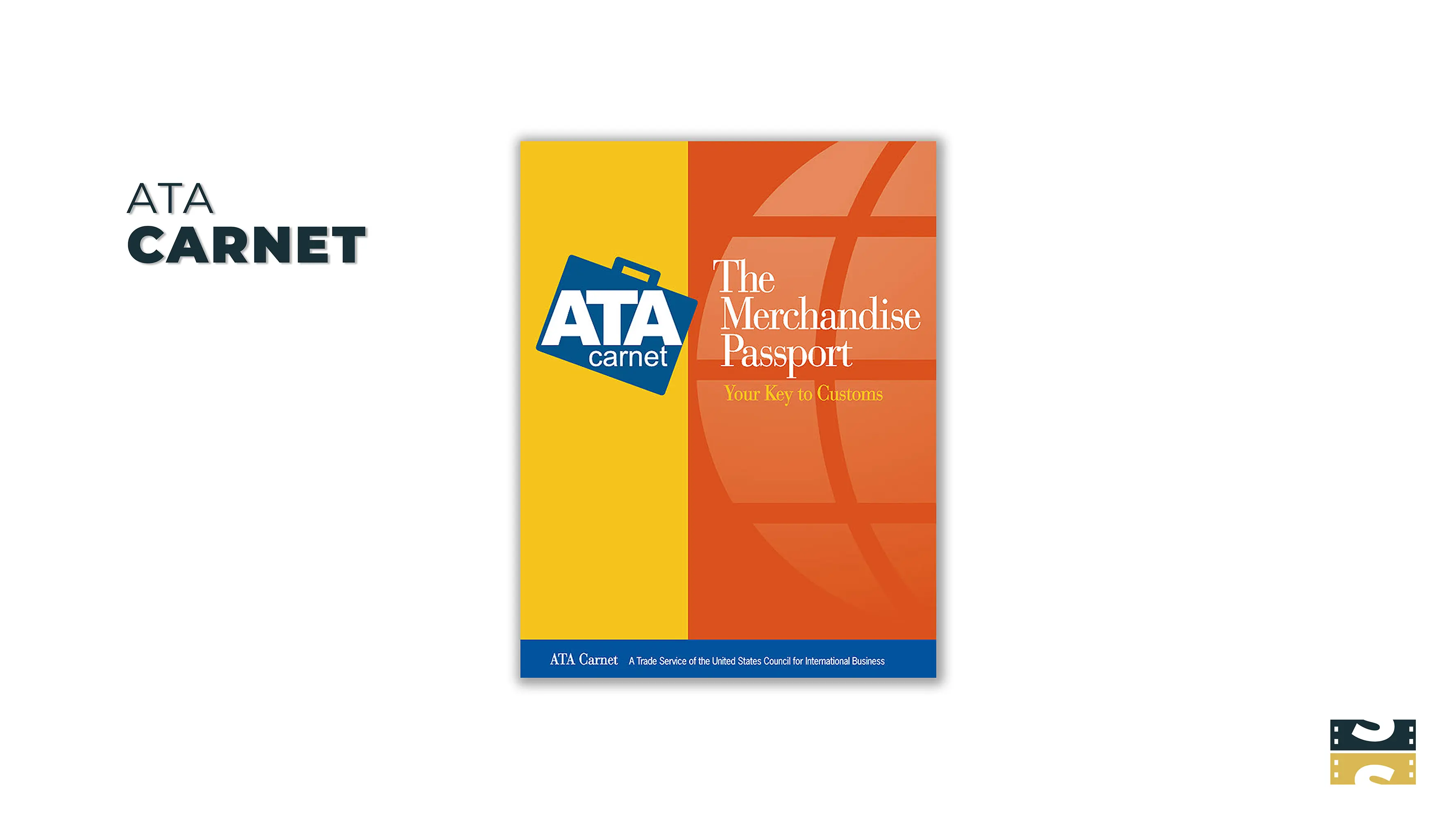
ATA Carnet
The ATA Carnet: A Passport for Your Gear
An ATA Carnet acts as a "passport for goods," allowing temporary importation of professional equipment without paying duties or taxes. However, it requires meticulous preparation and formal activation prior to departure.
Before applying for a Carnet (such as through Easy Carnet), the crew must document every single piece of gear traveling internationally. This information must be compiled in the exact format required by the items-template.csv. Every item entry must accurately document:
Description: Clear, specific detail of the equipment (e.g., Sony FX9 Camera Body, Arri Skypanel).
Serial Number: Must be exact, as customs officers will cross-reference this physically.
Quantity: The number of items for that specific line entry.
Weight: Accurate weight for the item or case.
Value: The current replacement value of the equipment.
Manufacture Country: The country where the item was originally manufactured.
Any discrepancy between this template list and the physical gear packed can result in the Carnet being rejected.
The Critical Pre-Departure Activation Step Before boarding the international flight, the crew is required to physically stop by the U.S. Customs and Border Protection (CBP) Port Authority or Customs Office. This office is not always located inside the main passenger terminal.
Call Ahead: Prior to travel day, the crew must call the local CBP Port of Entry to verify their hours of operation and their exact physical location. In St. Louis, for example, the primary CBP office is located off-site at 4349 Woodson Rd, and operates Monday-Friday from 8:00 a.m. to 4:30 p.m.
Physical Inspection: The crew must present all production gear to a CBP officer. The officer will physically inspect the equipment to verify that the items and their respective serial numbers perfectly match the Carnet’s approved "General List."
The Activation Stamp: Once the inspection is approved, the CBP officer will stamp the front cover of the Carnet and the yellow "Exportation Counterfoil."
Compliance Warning: This stamp formally activates the Carnet. If the crew attempts to enter a foreign country without this U.S. departure stamp, foreign customs authorities will likely reject the document. This is a crucial step that cannot be skipped, as failure to activate the Carnet will result in severe entry delays, heavy import penalties, or potential confiscation of the equipment.
II. Work Visas, Documentation, and Immigration Compliance
Immigration laws vary by country, but the requirement for a work visa generally hinges on the ultimate purpose and distribution of the content being produced, rather than the scale or head count of the event.
US Passport
The "Internal Use Only" Exemption vs. Commercial Work
Internal Corporate Filming (No Work Visa Generally Required): Filming a corporate event, training, executive meeting, or private internal summit where the resulting video content is strictly distributed internally to company employees typically qualifies under standard business travel status.
Commercial Filming (Work Visa Required): If the content is intended for public distribution, external commercial broadcast, advertising, the trip is classified as commercial work. This requires a formal employer-sponsored work or media visa, which can take 3 to 6 weeks to process and incurs additional government and consular fees.
Mandatory Client Approval Letter
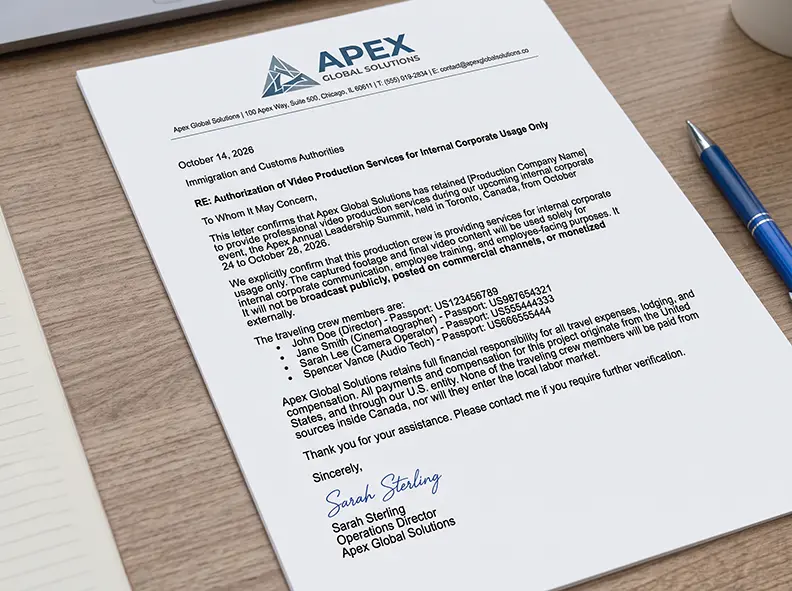
To verify the internal nature of the work and prevent immigration holds, the crew must carry a formal Internal Usage Written Approval Letter issued by the client/hiring company. This must be printed on company letterhead, signed by an authorized manager, and include:
Explicit confirmation that the production crew is providing professional video services for internal corporate usage only.
A clear statement that the content will not be broadcast publicly, posted on commercial channels, or monetized externally.
The names, passport numbers, and roles of all traveling crew members.
The specific dates, locations, and name of the internal corporate event/meeting.
A statement of financial responsibility confirming the hiring company covers all travel expenses and crew compensation from the country of origin.
Sample Approval Letter
Why this specific letter is required (Client Guide)
The "statement of financial responsibility" and detailed "internal usage" phrasing are necessary to confirm with border control officers that a crew arriving with heavy production gear is not working commercially.
The financial responsibility clause proves the crew is paid by a U.S. entity and is not entering the country to earn a local, untaxed salary.
The "internal usage" wording provides the exact legal criteria required for a business visitor exemption, proving the crew is acting as visiting corporate vendors rather than local laborers.
Required Document Packet
Immigration officers rely heavily on visual cues and will question teams traveling with heavy equipment cases. Every crew member must carry a physical folder containing:
Their individual copy of the Signed Manager Approval Letter.
Round-trip flight itineraries and hotel confirmations.
Note on the Carnet: Because there is only one physical, legally stamped ATA Carnet document, it will be held by the designated Lead Producer or Carnet Holder. All other crew members should direct customs officers to that individual if questioned about the equipment.
III. Escalation and Dispute Resolution
If an immigration or customs officer stops the crew despite having valid business travel status and internal documentation, the crew should follow these escalation steps:
Request a Supervisor: Calmly request to speak with a supervisor or duty director to present the manager-signed approval letter and equipment carnet.
Contact the Hiring Company: Have the local or U.S.-based hiring manager who signed the approval letter available by phone to verify the internal scope of the shoot directly to border control.
Consular Assistance: If an impasse occurs, contact the nearest U.S. Embassy or Consulate. While they cannot override local laws or force border control to bypass regulations, they can monitor the crew's treatment, ensure fair access to local legal avenues, and assist in clarifying legitimate corporate business activities with local authorities.
The Bottom Line
International shoots don't have to be stressful. Activate the Carnet before you fly. Be clear on where the content is going. Carry the documents that prove it. Those three habits prevent the vast majority of problems at the border.
One quick note. Every country has its own rules, and they change. Always confirm the current requirements for your destination before you book travel.
At SplyceHouse, we handle these kind of logistics so our clients don't have to. Whether the event is down the street in St. Louis or across an ocean, we want to be the creative partner who shows up ready, paperwork and all.
Planning an Event Overseas?
Let's talk through your international shoot before the travel gets booked. We'll help you map out the gear, the paperwork, and the timeline.